
Visit Carleton! Book your tour today.
Program Details
If it moves, it’s mechanical—and that makes mechanical engineers indispensable. From crash tests that improve vehicle safety to gas turbine engines that reduce emissions while delivering reliable performance, mechanical engineering is all around us.
Mechanical Engineering students build analytical, computational, and career-ready skills across key areas: design, dynamics, thermodynamics, heat transfer, fluid and solid mechanics, materials, control systems, and robotics.
Labs and Facilities
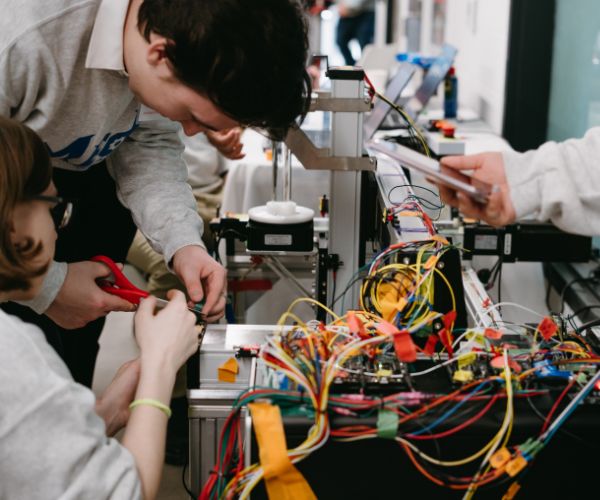
In the Bachelor of Mechanical Engineering degree, students have access to state-of-the-art facilities, including design-oriented spaces. Through courses in CAD/CAM (Computer-Aided Design and Computer-Aided Manufacturing), 3D modeling software, and advanced manufacturing techniques like 3D printing and CNC (Computer Numerical Control) machining, you’ll gain the skills to take your ideas from concept to creation.
Co-op
Carleton offers students a paid Co-op option with work terms of 4, 6, 8, 12 or 16 months.
Work Experiance
Ottawa is home to one of Canada’s largest concentrations of government agencies and high-tech companies. You’ll also benefit from Ottawa’s thriving tech sector, which includes automotive design, biotechnology manufacturing and much more.

Get started in Carleton360 to receive tailored information on our programs, student services and community.
Career Outcomes
Explore your passions, refine new skills and discover the career that’s right for you.
Mechanical engineering is among the most versatile of all disciplines, giving students many career opportunities in various industries.
Sample Courses
MAAE 2700 - Engineering Materials
Materials (metals, alloys, polymers) in engineering service; relationship of interatomic bonding, crystal structure and defect structure (vacancies, dislocations) to material properties; polymers, phase diagrams and alloys; microstructure control (heat treatment) and mechanical properties; material failure; corrosion.
MECH 4104 - Vibration Analysis
Free and forced vibrations of one and two degree-of-freedom systems. Vibration measurement and isolation. Numerical methods for multi-degree-of-freedom systems. Modal analysis techniques. Dynamic vibration absorbers. Shaft whirling. Vibration of continuous systems: bars, plates, beams and shafts.
Visit the Undergraduate Calendar to view a comprehensive list of course offerings for this program and discover the exciting things Carleton students are learning in the classroom!