
Visit Carleton! Book your tour today.
Program Details
From surgical robots that allow minimally invasive surgeries to wearable devices that track your steps and your sleep patterns, technology is playing an increasingly important role in health care. A modern hospital runs thousands of devices that diagnose and treat diseases. To deliver effective devices, they need to be precisely calibrated and function as a cohesive system. Biomedical and electrical engineers are the ones who make it all happen.
The Bachelor of Biomedical and Electrical Engineering program combines electrical and computer engineering to design life-changing medical technologies. Students learn to develop everything from pacemakers and remote patient monitoring systems to medical imaging devices like MRIs, ultrasounds and X-rays. You’ll build expertise in electromagnetism, materials, signal processing, systems engineering, and quantitative analysis—skills essential for creating safe, effective and innovative medical devices.
Labs and Facilities
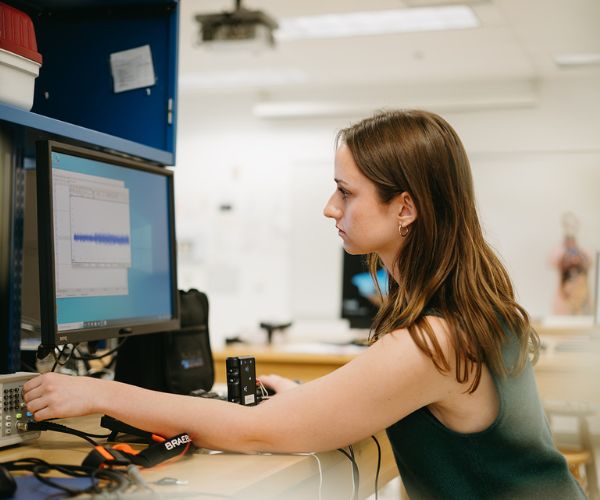
Carleton’s Biomedical and Electrical Engineering program blends natural sciences, electronics, computer architecture, and bioinstrumentation with training in ethics, research methods, and industry standards specific to the discipline. Students can choose electives in image processing, surgical robotics, integrated sensors, and clinical engineering while gaining hands-on experience in state-of-the-art facilities like the Biomedical Engineering Lab, the BioMechatronics Lab and the Microfabrication Facility. These spaces support work in medical device design, biosignal monitoring, smart systems and microdevice fabrication.
Co-op
Carleton offers students a paid Co-op option with work terms of 4, 6, 8, 12 or 16 months.
Work Experience
Ottawa is home to one of Canada’s largest concentrations of government agencies and high-tech companies. Located near campus is Kanata North, Canada’s largest technology park—offering Carleton students a direct pipeline to hundreds of companies looking for talent in biomedical and electrical engineering.

Get started in Carleton360 to receive tailored information on our programs, student services and community.
Career Outcomes
Explore your passions, refine new skills and discover the career that’s right for you.
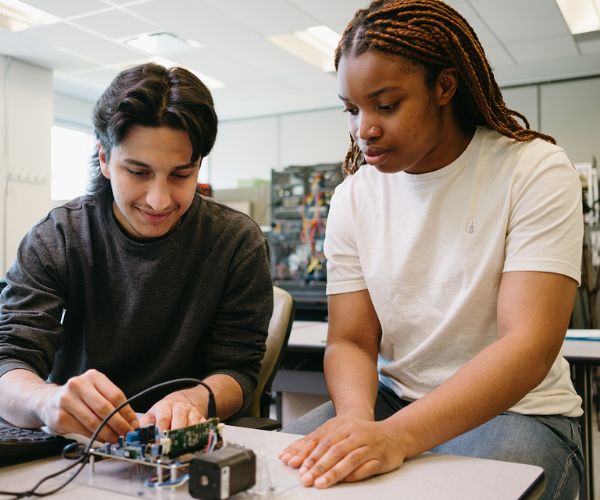
With a foundation in electrical engineering, Biomedical and Electrical Engineering students will have the skills to work both in the biomedical engineering and electrical engineering industries.
Sample Courses
SYSC 2510 - Probability, Statistics and Random Processes for Engineers
Discrete and continuous random variables. Joint and conditional probabilities, independence, sums of random variables. Expectation, moments, laws of large numbers. Introduction to statistics. Stochastic processes, stationarity, additive white Gaussian noise, Poisson processes. Markov processes, transition probabilities and rates, birth death processes, introduction to queueing theory.
SYSC 4203 - Bioinstrumentation and Signals
Bioinstrumentation and biological signals; instrumentation systems, electrical safety, and biocompatibility; bioelectric signals; biopotential electrodes: material properties, selection; data acquisition; signal processing; biomedical imaging technologies; bioamplifier systems performance and characteristics; major physiological systems and associated measurements.
Visit the Undergraduate Calendar to view a comprehensive list of course offerings for this program and discover the exciting things Carleton students are learning in the classroom!