
Visit Carleton! Book your tour today.
Program Details
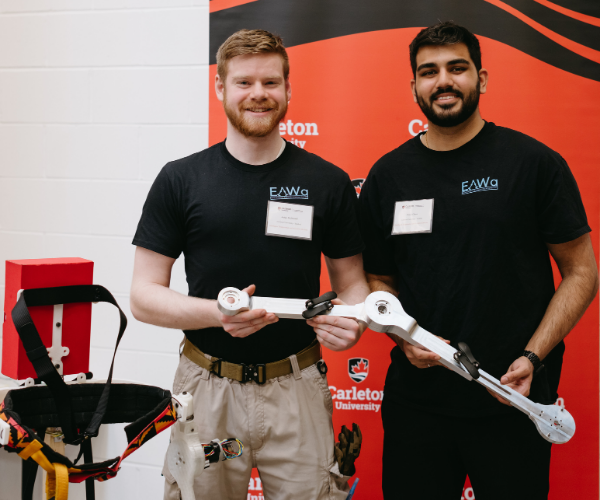
From bionic limbs and assistive devices that restore mobility to engineered tissues used in regenerative medicine, mechanical innovation is transforming patient care. Biomedical and mechanical engineers design, build, and refine the technologies that support diagnosis, treatment, and recovery. Whether it’s a wearable device or a life-saving implant, they apply mechanical engineering principles to life sciences challenges, all with the goal of improving human health.
The Bachelor of Engineering in Biomedical and Mechanical Engineering prepares you to create technologies that support healing, mobility, and recovery. You’ll learn how to design systems that work in harmony with the human body—and gain the skills to thrive in Ontario’s life sciences cluster, the largest of its kind in Canada.
Labs and Facilities
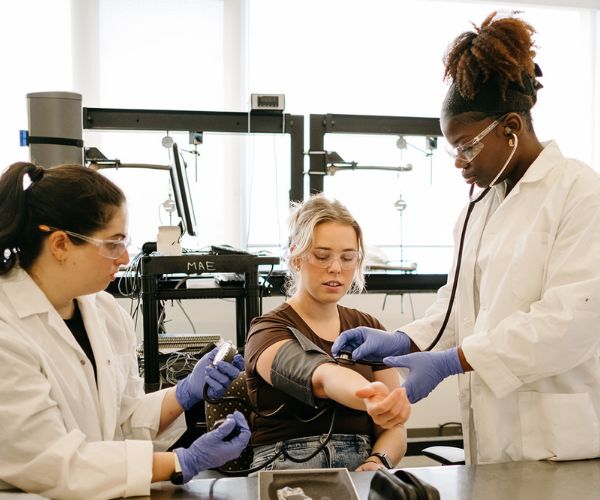
Students gain experience in state-of-the-art facilities such as the Biomedical Engineering Lab, the BioMechatronics Lab, the Solid Mechanics Lab and the Microfabrication Facility. These spaces support work in human anatomy, biomechanics and biomaterials. You’ll build expertise in emerging medical technologies like 3D bioprinting, which creates tissues and organs used in regenerative medicine.
Co-op
Carleton offers students a paid Co-op option with work terms of 4, 6, 8, 12 or 16 months.
Work Experience
Ottawa is home to one of Canada’s largest concentrations of government agencies and high-tech companies. Located near campus is Kanata North, Canada’s largest technology park—offering Carleton students a direct pipeline to hundreds of companies looking for talent in biomedical and mechanical engineering.

Get started in Carleton360 to receive tailored information on our programs, student services and community.
Career Outcomes
Explore your passions, refine new skills and discover the career that’s right for you.
With a foundation in mechanical engineering, Biomedical and Mechanical Engineering students will have the skills to work both in the biomedical engineering and mechanical engineering industries.
Sample Courses
MECH 3310 - Biofluid Mechanics
Applications of fundamental fluid mechanics to human circulatory and respiratory systems. Basic viscous flow theory including: blood flow in the heart and large arteries, air flow in extra-thoracic (nose-mouth throat) airways and lungs.
MECH 4104 - Vibration Analysis
Free and forced vibrations of one and two degree-of-freedom systems. Vibration measurement and isolation. Numerical methods for multi-degree-of-freedom systems. Modal analysis techniques. Dynamic vibration absorbers. Shaft whirling. Vibration of continuous systems: bars, plates, beams and shafts.
Visit the Undergraduate Calendar to view a comprehensive list of course offerings for this program and discover the exciting things Carleton students are learning in the classroom!